
Learn · Part 2 of 4
Craniofacial Development and Airway Health
The way our face, jaws, tongue, and airway develop can influence how we breathe, sleep, eat, and function throughout life.
Structure and function grow together
Our faces and jaws do not develop independently of how we use them. From childhood onward, breathing patterns, tongue posture, chewing, swallowing, genetics, and growth all contribute to the relationship between structure and function.
The tongue is especially important. At rest, it normally rests gently against the palate, with the lips comfortably closed and breathing occurring through the nose.
During development, the forces created by the tongue, lips, cheeks, and chewing muscles interact with growing bones. When these functions are altered, the balance of forces can change.
How we use our muscles can influence development, and the structures we develop can influence how those muscles function.
Why the airway matters
Your airway is the passage that allows air to move between your nose, throat, and lungs. Its size, shape, and surrounding tissues influence how easily air can move, particularly during sleep.
When awake, our muscles actively help maintain an open airway. During sleep, muscle activity changes. For some people, this makes the airway more vulnerable to narrowing or obstruction.
The body may respond with increased breathing effort, brief awakenings, or changes in sleep continuity. These interruptions are not always remembered in the morning.
Some people experience snoring or obvious breathing disturbances. Others primarily notice fatigue, restless sleep, morning headaches, or difficulty concentrating.
These symptoms can have many causes, which is why careful evaluation matters.
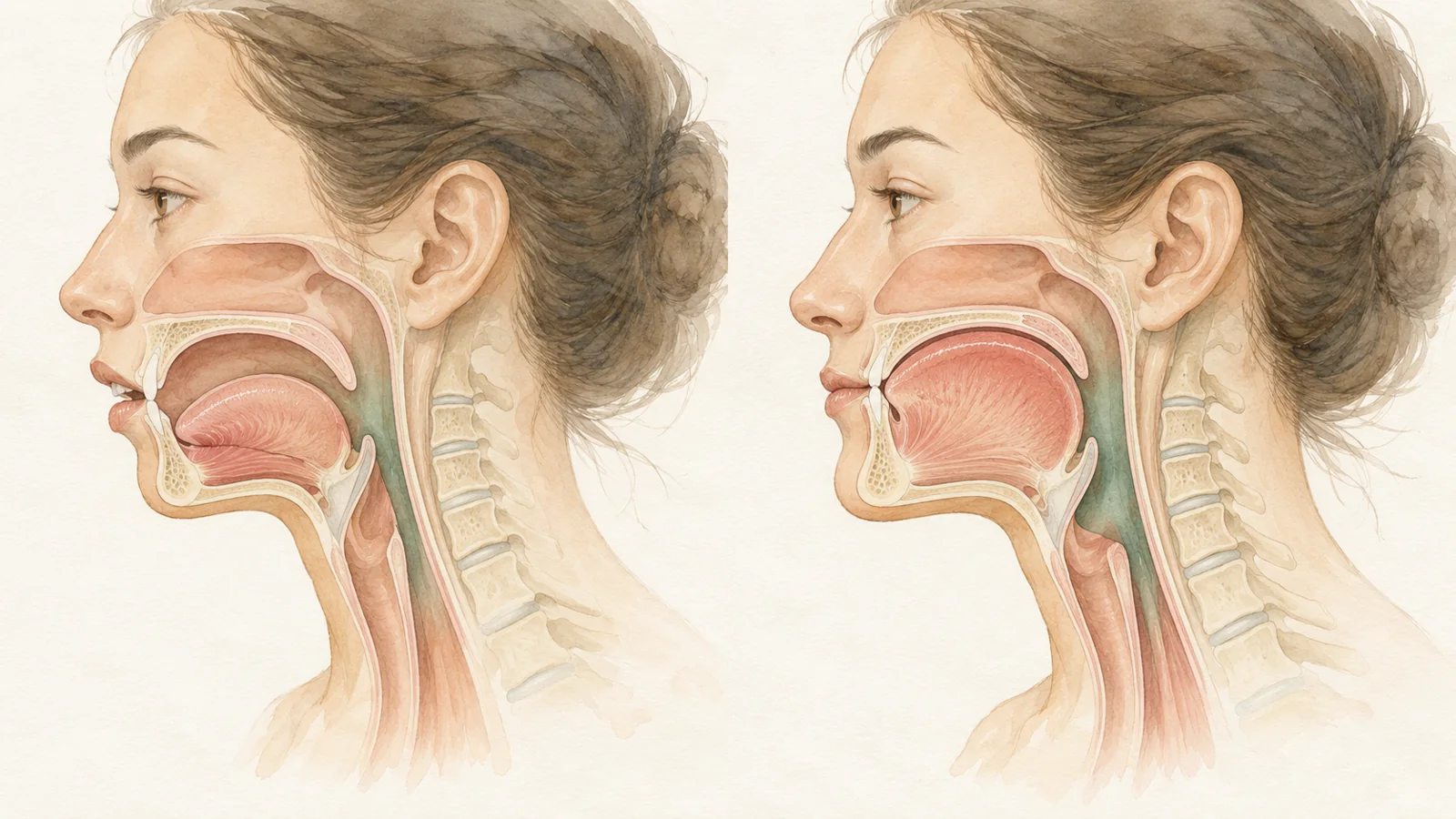
The relationship between the nose, tongue, and jaw
Breathing through the nose is an important part of normal respiratory function. The nose warms, filters, and humidifies incoming air. It also produces nitric oxide, which participates in several physiological processes.
Comfortable nasal breathing can help support a natural resting relationship between the lips, tongue, and jaw. But nasal breathing is not equally accessible to everyone.
Allergies, congestion, structural differences, and other conditions may make it difficult. Likewise, a tongue that cannot move or rest comfortably against the palate may influence swallowing, oral posture, and muscular coordination.
These relationships are worth understanding before deciding which intervention may be helpful.
Why structure alone does not tell the whole story
Two people can have similar jaw structures and experience very different symptoms. One may sleep comfortably, while the other struggles with fatigue, muscle tension, or disturbed sleep.
That is because structure is only part of the picture. Muscle function, breathing behavior, nervous system regulation, sleep physiology, and the body's ability to adapt also matter.
An anatomical finding does not automatically explain a person's symptoms or establish the need for treatment.
We need to understand not only what the body looks like, but how it functions.
Understanding before intervention
Orthodontic treatment, dental appliances, airway procedures, and tongue tie release may be appropriate for some individuals. Each addresses a particular aspect of structure or function.
But changing a structure does not necessarily teach the muscles how to work differently. And improving muscle function cannot always overcome a significant structural limitation.
This is why thoughtful evaluation and coordination among healthcare professionals matter. At Breathe Colorado Wellness, we explore the relationship between facial structure, oral muscle function, breathing, and sleep.
The goal is to identify what may be limiting function, what may be responsive to therapy, and when additional evaluation or care is appropriate.
The most useful question is not simply what needs to change, but what the body needs in order to function well.
Breathe effortlessly. Be well. · Laura Barlow, CBBA, CSOM, INHC