
Learn · Part 4 of 4
Why Breathing Comes Before Tongue and Jaw Function
Before asking the muscles of the mouth, tongue, and jaw to change, we need to understand the conditions in which they are working.
The body works as a connected system
Your tongue does not function in isolation. Neither does your jaw, diaphragm, neck, or airway.
These structures participate in a coordinated system that supports breathing, swallowing, speaking, eating, and posture. When one part of that system is working harder than it should, other muscles may adapt to help.
These adaptations are often useful in the short term. But over time, they can become established patterns of movement and tension.
Before we ask a muscle to work differently, we need to understand what it has been working around.
The diaphragm does more than help you breathe
The diaphragm is a large, dome shaped muscle beneath your lungs. It is the primary muscle responsible for drawing air into the lungs during quiet breathing.
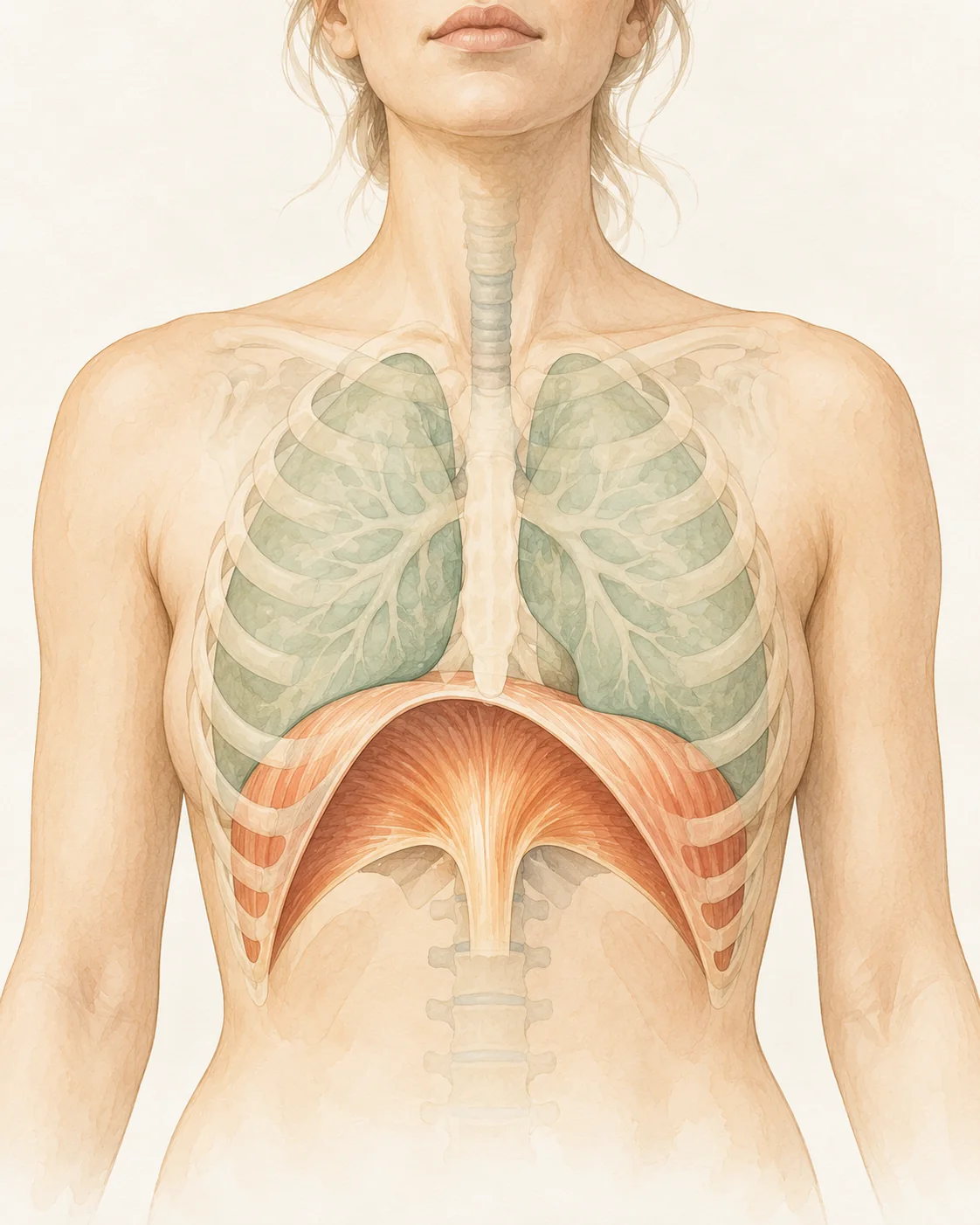
As it contracts, it moves downward, helping the lungs expand while the rib cage moves in coordination. The diaphragm also participates in the regulation of pressure within the abdomen and contributes to trunk stability.
Its movement works alongside the abdominal muscles, pelvic floor, and muscles surrounding the spine. When breathing mechanics become inefficient, the body may recruit additional muscles to assist.
This can contribute to increased effort through the neck, shoulders, and upper chest.
Learning to coordinate the diaphragm and rib cage can help reduce unnecessary effort and support more adaptable breathing.
Good breathing mechanics are only part of the picture
It is possible to move the diaphragm well and still breathe more air than your body needs. That is why we consider both breathing mechanics and respiratory chemistry.
The diaphragm helps determine how air moves. Carbon dioxide regulation helps us understand whether the amount of breathing is appropriate for the body's metabolic needs.
Both matter. A person may need help coordinating their breathing muscles, reducing unnecessary breathing effort, or recognizing habits that alter carbon dioxide levels.
Our goal is not simply diaphragmatic breathing. It is comfortable, coordinated breathing that meets the body's needs.
Why this matters for the tongue and jaw
The muscles of the tongue, jaw, lips, and throat work closely with the structures involved in breathing and swallowing. If someone struggles to breathe comfortably through the nose, maintaining closed lips and a relaxed tongue resting position may be difficult.
If the neck and jaw are frequently recruited to assist with breathing or stabilization, these patterns may influence how oral exercises are performed. And if a person habitually holds their breath or uses excessive effort during movement, those habits may appear during tongue and jaw exercises as well.
We want to recognize these relationships rather than train a new movement on top of an existing compensation.
Preparing for myofunctional therapy
Orofacial myofunctional therapy helps develop awareness, strength when needed, coordination, and appropriate patterns of muscle use. But before progressing through exercises, it is useful to understand how the person breathes at rest and whether they can perform movements without unnecessary tension or breath holding.
For some clients, breathing behavior training is an important first step. For others, breathing and myofunctional therapy can progress together. The sequence depends on the individual's assessment.
We are not simply teaching the tongue where to go. We are helping the body develop the conditions that allow it to function there comfortably.
What about tongue tie release?
A tongue tie is a restriction involving the tissue beneath the tongue that may limit movement or function. For some people, a release procedure may be appropriate after careful evaluation.
However, releasing restricted tissue does not automatically establish new patterns of movement. The tongue still needs to develop the ability to move, coordinate, and participate in daily functions such as swallowing and resting posture.
Myofunctional therapy may help address these skills before and after a procedure when indicated. Breathing assessment can also identify behaviors or limitations that deserve attention as part of the larger plan.
Not every tongue tie requires release, and not every person needs breathing therapy before a procedure.
What matters is understanding the individual's function and preparing appropriately.
Capacity before complexity
It can be tempting to focus on the most visible limitation first. But meaningful progress often begins with understanding the body's current abilities.
- Can the person breathe comfortably?
- Can they coordinate movement without excessive effort?
- Can they recognize tension and allow it to soften?
- Can they perform a simple movement consistently before progressing to a more complex one?
These questions guide how we approach therapy.
We begin with what the body can do, build upon that capacity, and introduce greater complexity when it is ready.
Breathe effortlessly. Be well. · Laura Barlow, CBBA, CSOM, INHC